The Written Word Is Not Sacred — So Fact Check!
3January 29, 2013 by fixignorant
As my english teacher often said, “The written word is not sacred. Just because you see something in print, doesn’t mean it’s true.”
Back then, in the printing press era, that was a sensible warning. Sure, editors and publishers were gatekeepers, and the good ones kept a lot of the nonsense from making it into print, but they couldn’t stop all of it.
These days, in the online era, it’s an essential warning. Along with the edited material we purchase, a flood of unedited stuff gets dumped on us every day. We’ve all become the gatekeepers but a lot of us haven’t even noticed, much less gotten good at it. Too much of what email, facebook, Twitter and the like bring our way is misinformation and it’s being passed along without a second look.
Why should we care about this nonsense? (As opposed to the entertainment and legitimate nonsense — jokes, satire, tweaked pictures, etc. — that we do want.)
We should care because, just as our understanding of the world is shaped by good information, it’s warped by misinformation. If we’re unaware of the existence of fallacies, they can twist how we see the world, what we think, how we feel about things, the actions we take and what comes of our actions. Each time that we’re moved by a lie or a mistake we become a little less in touch with reality.
We should care because staying reasonably in touch with reality requires us to have a good idea about what we’re sure of and what we’re not. If we’re aware of the existence of fallacies, but don’t bother to weed them out, we slide into either gullibility or cynicism. Simply taking what comes at face value is easy, but it undermines our certainty. Mistrusting everything instead, may make us feel smarter, but it leads to the same uncertainty. Arbitrarily deciding what to believe is no better.
We should care because in a world where it’s impossible to know everything, choosing what is worthwhile for us to know, and seeing to it that we’ve got our facts as straight as we can is the best that we can do. Then, if the things we see online make us feel outraged or inspired, amused or saddened, attracted or repulsed, frightened or calmed, depressed or uplifted, we can trust our feelings.
If we do care, the fix for a lot of this nonsense is really simple. Fact check!
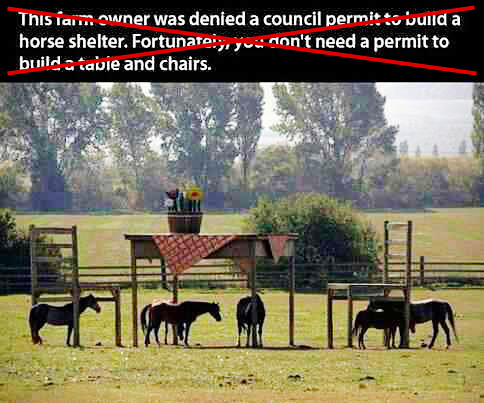
The next time you see a post about horses under a giant table, or money being raised to help an abused puppy, or words of wisdom from a brightly dressed old lady, or an Australian dentist sticking up for Canadians, or someone’s lost child, or a miracle cure for cancer, or your favourite vegetable being poisonous, or 50 free iPads, or facebook owning your first born, or… whatever… do not share it without first checking it out. It’s easy and it only takes a minute or two.
You can go to:
- Snopes.com
- Hoaxslayer.com
- TruthOrFiction.com
- Urbanlegends.about.com
- facecrooks.com
- QuoteInvestigator.com
- (There are others that focus mainly on politics.)
Another easy way to check is to select and copy the first sentence, or some other easily identifiable part of the post, and paste it into whichever search engine you use; Google, Bing, Duck Duck Go… That will usually take you to that subject in one or more of the sites listed above, where you can find out if you’re dealing with the truth or not.
If it’s true, that’s great. Pass it along if you’re moved to do so.
If it’s not true, delete it and pass the news back to whomever posted it. I cannot stress the need to delete it too strongly. I regularly see posts being left up long after someone has pointed out in the comments section that they’re not true, and even provided a link to one of the sites above. I also see those same posts continue to be ‘liked’ and ‘shared’ by people who haven’t seen that correction in the comments section. Until you take it down, it’s still polluting peoples minds. If you don’t want to lose the comments, just select the whole works and paste them into a word processing document first.
If it’s partly truth and partly fiction, as many are, that’s trickier. You can add the link that details which is which to the comments section, but this does little for the people who aren’t looking there. If it’s important enough to you, you can redo the post correctly, or set it up on a new page that includes a link to the corrections.
Lastly, here are some tips for spotting this kind of nonsense. It’s a big old world with billions of people on it and absolutely outrageous things do happen, so we can’t automatically rule out the bizarre. And lots of credible people like to post things and write about them, so we can’t automatically rule out everything that isn’t from a recognizable media source. Nevertheless, if it’s outrageous, it needs to be checked. If it isn’t from the established media (and sometimes even if it is), you need to check it. If no one has put their name to it, if there are no dates, if it’s gathering ‘likes’ or ‘shares’ for a cause but there’s no page to go to see how the campaign is going, if they’re giving away expensive stuff, if it’s about a miracle cure, or a horrible problem with an everyday food or product, if it claims some well known person or company is doing something horrible, if it blatantly plays to emotion, nationalism or prejudice, etc… it should be double-checked.
Any of these things may be real, but there’s a good chance that they’re not, so take a minute and find out. The more you do this, the better you get at it, and the more interesting it becomes. For bonus points, when posts use creative content without crediting the writers and visual artists, you can look for their names and add them to the post. The TinEye extension can help to track down images. Text can simply be searched.
(There are, of course, other less obvious and more sinister forms of misinformation than the category that I’m addressing here and I’ll look into them in other posts.)
It’s past time to clean up the litter on the information highway. Let’s get to it. I thank you. Reality thanks you.
Terry McTavish
P.S. Please share information and corrections with kindness and humour. As explained here, https://fixignorant.com/2013/01/06/you-can-fix-ignorant/ , the intention is to reduce the misinformation that contributes to ignorance, not to attack the ignorant — that’s all of us, to one degree or another. Accordingly, any meanspirited comments that I find here, will be deleted.
If you would like to be notified about new posts, just click the follow button.
 You Can Fix Ignorant
Thanks for this! Very informative and helpful!
OK, thanks! I’m going to start doing this.
Passing it on Terry, which is one of the blessings of the information highway…Thanks again for the directory…(Maggie)